Cite this content: Smith, Cassander L. “Writing race, acting race in the Anglo-Atlantic world.” Throughlines. www.throughlines.org/suite-content/writing-race-acting-race-in-the-anglo-atlantic-world. [Date accessed].
Writing race, acting race in the Anglo-Atlantic world
Origins of race and racial performance in English literature

Course description
This graduate course will appeal to students interested in early modern literature, including those invested in early American and early African American literature. We will view early modern literature from a transatlantic perspective, examining development of racial discourses in the literature—resulting from English/New World encounters with Black Africans and Native Americans. This course applies the underlying principle of critical race theory: that race has had a profound effect on the social, legal, historical, and literary structures that comprise United States culture. To better understand how U.S. culture arrived at this point, students will journey back to 16th and 17th-century England to examine the earliest manifestations of racial discourses in an ever-expanding English-American empire.
Students should pursue this course while keeping in mind the warnings from race theorists who caution against applying the term ‘race’ to earlier historical periods in which people were classified based on cultural distinctions, not biological ones. They point out that our contemporary understanding of ‘race’ as a scientific, biologically based system of difference is an invention of late 18th and 19th-century scientists. However, as pointed out both by Maria Elena Martinez in Genealogical Fictions and Geraldine Heng in The Invention of Race, in properly historicizing the term ‘race,’ we should be careful not to dismiss its presence and function in earlier periods. Students will operate on the assumption that racial discourses developed before the 19th century and that such discourses were an integral part of early European imperial projects.
The class will focus specifically on the English: students will examine how the English wrote about ‘race,’ how they categorized people based on cultural and geographical differences, and how they defined themselves based on those differences. This course will emphasize the stakes and the problems racial classification created for each writer in the English empire. Why did race matter, how did it matter, and what did these writers do when they encountered figures in the Americas whose actions defied racial classification?
Equally important, students will interrogate the Black experience during this period. What did it mean to be Black in the early Atlantic world? How did early Black writers and thinkers talk about race? How did they engage their environs in ways that accommodate, challenge, or reshape the racial discourses of the day? These questions will not only help students theorize race in the early modern Atlantic from the perspective of Black Africans and Natives, but will also help them reorient their mindset by taking seriously Black Africans as intellectuals and as cultural doers during the early modern period.
Course objectives
- Define critical race theory.
- Identify the tenets of premodern critical race studies.
- Apply critical race theory to early modern primary texts.
- Recall pertinent historical, social, political, and cultural issues that characterized English colonial imperial agendas.
- Analyze and critique relevant secondary criticism.
- Write responses that illustrate an understanding of the racial themes and tensions that characterize early English Atlantic literature.
- Approach texts from multiple angles, reading with and against the grain.
Required texts
Morrison, Toni. Playing in the Dark: Whiteness and the Literary Imagination (Harvard University Press, 1992).
Hall, Kim. Things of Darkness: Economies of Race and Gender in Early Modern England (Cornell University Press, 1995).
Course schedule
Week 1 - What is race? What is critical race theory?
Baldwin, James, and Randall Kenan. “Why I Stopped Hating Shakespeare.” The Cross of Redemption: Uncollected Writings (Vintage Books, 2011).
Delgado, Richard and Jean Stefancic. Critical Race Theory: An Introduction (NYU Press, 2017): pp. 1-34.
Week 2 - What is premodern critical race studies?
Erickson, Peter and Hall, Kim. “‘A New Scholarly Song’: Rereading Early Modern Race.” Shakespeare Quarterly, no. 67.1 (Spring 2016): pp. 1-13.
Hendricks, Margo. “Race: A Renaissance Category?” Companion to English Renaissance Literature and Culture, ed. Michael Hattaway (Blackwell, 2003): pp. 690-98.
Hendricks, Margo. “Coloring the Past, Rewriting Our Future: RaceB4Race.” Folger Shakespeare Library (September 2019). https://www.folger.edu/institute/scholarly-programs/race-periodization/margo-hendricks.
Smith, Ian. “We Are Othello: Speaking of Race in Early Modern Studies.” Shakespeare Quarterly, no. 67.1 (Spring 2016): pp. 104-24.
Optional
Heng, Geraldine. “Defining Race, Periodizing Race.” Folger Shakespeare Library (September 2019). https://www.folger.edu/institute/scholarly-programs/race-periodization/geraldine-heng.
Week 3 - Blackness in the early modern (white) imagination
Primary
- Africanus, Leo. A Geographical History of Africa. 1600.
- Best, George. A True Discourse of the Travels of Martin Frobisher. 1578.
- Eden, Richard. “First English Voyages to Africa.” Principal Navigations. Hakluyt, Richard, ed. 1555.
- Mandeville, John. The Travels of Sir John Mandeville. 1350.
Secondary
Barthelemy, Anthony. “Chapter 1 Satan’s Livery: Blackness and the Western Tradition.” Black Face, Maligned Race: The Representation of Blacks in English Drama from Shakespeare to Southerne (Louisiana State University Press, 1987).
Hair, P.E.H.. “Early Sources on Guinea.” History in Africa, no. 21 (1994): pp. 87-126.
Morrison, Toni. “Black Matters.” Playing in the Dark: Whiteness and the Literary Imagination (Harvard University Press, 1993).
Vaughan, Alden T. and Virginia Mason Vaughan. “Before Othello: Elizabethan Representation of Sub-Saharan Africans.” The William and Mary Quarterly, Series 3, no. 54.1 (Jan. 1997): pp. 19-44.
Whitford, David. “This Heavy Curse: Popularizing the Curse of Ham.” The Curse of Ham in the Early Modern Era (Ashgate Publishing, 2009): pp. 105-140.
Optional
Gomez, Nicolás Wey. “Preface” and “Introduction” and “Chapter 1: Machina Mundi.” Tropics of Empire: Why Columbus Sailed South to the Indies (The MIT Press, 2008): pp. xiii-xvi, 3-57, 59-106.
Loomba, Ania and Jonathan Burton. Race in Early Modern England: A Documentary Companion (Palgrave, 2007).
Week 4 - Race as cultural aesthetics
Primary
Herbert, Edward. "Blackness Poems"
- “To Mrs. Diana Cecyll.”
- “To Her Eyes.”
- “The Brown Beauty.”
- “To Her Hair.”
- “Sonnet to Black Beauty.”
- “Another Sonnet to Black Itself.”
Herbert, George. “A Negro Maid Woos Cestus, a Man of a Different Color.”
Secondary
Hall, Kim F. “Introduction” and “Fair Texts/Dark Ladies: Renaissance Lyric and the Poetics of Color.” Things of Darkness: Economies of Race and Gender in Early Modern England (Cornell University Press, 1995): pp. 1-24, 62-122.
Week 5 - Black absence/presence in the early modern archives; beyond imagination
Primary
Drake, Francis. Sir Francis Drake Revived. 1573.
Secondary
Bumas, E. Shaskan. “The Cannibal Butcher Shop: Protestant Uses of las Casas's ‘Brevísima relación’ in Europe and the American Colonies.” Early American Literature, no. 35.2 (2000): pp. 107-36.
Hartman, Saidiya. “Venus in Two Acts.” Small Axe 26 12.2 (June 2008): pp. 1-14.
Smith, Cassander L. “Introduction: Black Africans, A Black Legend, and Challenges of Representation.” Black Africans in the British Imagination: English Narratives of the Early Atlantic World (Louisiana State University Press, 2016).
Optional
Habib, Imtiaz. Black Lives in the English Archives, 1500-1677: Imprints of the Invisible (Ashgate, 2008).
Hall, Kim F. “Reading What Isn’t There: ‘Black’ Studies in Early Modern England.” Stanford Humanities Review, vol. 3, no. 1 (1993): pp. 23-33.
Kaufman, Miranda. Black Tudors: The Untold Story (OneWorld Publications, 2017).
Smith, Cassander, L. “Africans in Early America.” A Companion to American Literature Vol I, eds. Susan Belasco and Theresa Strouth Gaul (Wiley Publishing, 2020).
Week 6 - Race and the power of an idea
Primary
Shakespeare, William. Othello.
Secondary
Morrison, Toni. “Romancing the Shadow.” Playing in the Dark: Whiteness and the Literary Imagination (Harvard University Press, 1993).
Smith, Ian. “Othello’s Black Handkerchief.” Shakespeare Quarterly, no. 64.1 (2013): pp. 1-25.
Optional
Chaplin, Joyce. Subject Matter: Technology, the Body, and Science on the Anglo-American Frontier, 1500-1676 (Harvard University Press, 2003).
Chapman, Matthieu. Anti-Black Racism in Early Modern English Drama: The Other “Other” (Routledge, 2017).
Grier, Miles P. “Staging the Cherokee Othello: An Imperial Economy of Indian Watching” The William and Mary Quarterly, no. 73.1 (January 2016): pp. 73-106.
Wheeler, Roxanne. The Complexion of Race: Categories of Difference in Eighteenth-Century British Culture (University of Pennsylvania Press, 2000).
Week 7 - Performing race
Primary
Shakespeare, William. The Tempest.
Secondary
Chaplin, Joyce. “Race.” The British Atlantic World, 1500-1800, eds. David Armitage, Michael Braddick (Red Globe Press, 2009): pp. 173-92.
MacDonald, Joyce Green. “Acting Black: Othello, Othello Burlesques, and the Performance of Blackness.” Theatre Journal, no. 46.2 (May, 1994): pp. 231-49.
Smith, Ian. “White Skin, Black Masks: Racial Cross-Dressing on the Early Modern Stage.” Renaissance Drama, no. 32 (2003): pp. 33-67.
Optional
Kumar, Rebecca. “‘Do You Love Me, Master?’: The Erotic Politics of Servitude in The Tempest and Its Postcolonial Afterlife.” Early Modern Black Diaspora Studies: A Critical Anthology, eds. Cassander L. Smith, et. al. (Palgrave Macmillan, 2018).
Kunat, John. "Play me false: Rape, Race, and Conquest in The Tempest,” Shakespeare Quarterly, no. 65.3 (Fall 2014): pp. 307-27.
Thompson, Ayanna. “The Blackfaced Bard: Returning to Shakespeare or Leaving Him?” Shakespeare Bulletin, no. 27.3 (Fall 2009): pp. 437-56.
Thompson, Ayanna. Passing Strange: Shakespeare, Race, and Contemporary America (Oxford University Press, 2011).
Week 8 - Whiteness and the invisibility of race
Primary
Jonson, Ben. Masque of Blackness (1605) and Masque of Beauty (1608).
Secondary
Hall, Kim F. “Dramas of Alliance.” Things of Darkness: Economies of Race and Gender in Early Modern England (Cornell University Press, 1995).
Optional
Barthelemy, Anthony. “Beauty’s Beast: Blacks in the Court Masque.” Black Face, Maligned Race: The Representation of Blacks in English Drama from Shakespeare to Southerne (Louisiana State University Press, 1987).
Callaghan, Dympna. “‘Othello was a white man’: Properties of Race on Shakespeare’s stage.” Shakespeare Without Women: Representing Gender and Race on the Renaissance Stage (Routledge, 2000).
Hall, Kim F. “‘These Bastard Signs of Fair’: Literary Whiteness in Shakespeare’s Sonnets.” Post-Colonial Shakespeares, eds. Ania Loomba and Martin Orkin (Routledge, 1998).
Royster, Francesca. “White-limed Walls: Whiteness and Early Gothic Extremism in Shakespeare’s Titus Andronicus.” Shakespeare Quarterly, no. 51. 4 (2000): pp. 432-55.
Week 9 - Whiteness and empire
Primary
Behn, Aphra. Oroonoko; or, The Royal Slave. 1688.
Secondary
Hudson, Nicholas. “From Nation to Race: The Origin of Racial Classification in Eighteenth Century Thought.” Eighteenth-Century Studies, no. 29.3.
Mallipeddi, Ramesh. “Spectacle, Spectatorship, and Sympathy in Aphra Behn's Oroonoko.” Eighteenth-Century Studies, no. 45.4 (Summer 2012): pp. 475-96.
Optional
Dillon, Elizabeth Maddock. “Introduction” in New World Drama: The Performative Commons in the Atlantic World, 1649-1849 (Duke University Press, 2014).
MacDonald, Joyce Green. “The Disappearing African Woman: Imoinda in "Oroonoko" after Behn,” ELH, no. 66.1 (Spring, 1999): pp. 71-86.
Week - 10 Toward a theory of Black experience
Primary
Equiano, Olaudah. The Interesting Narrative of the Life of Olaudah Equiano, Or Gustavus Vassa, the African.
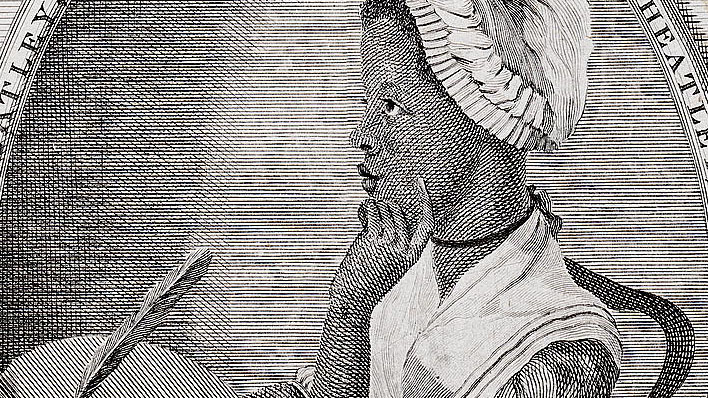
Wheatley, Phillis – from Poems on Various Subjects, Religious and Moral
- “On Being Brought from Africa to America”
- “On Virtue”
- “To S.M.”
Letter to Samson Occom
Selected Letters to Obour Tanner
Secondary
Bynum, Tara. “Phillis Wheatley on Friendship,” Legacy, no. 31.1 (2014): pp. 42-51.
Marren, Susan. “Between Slavery and Freedom: The Transgressive Self in Olaudah Equiano’s Autobiography.” PMLA, no. 108.1 (Jan. 1993): pp. 94-105.
Optional
Caldwell, Tanya. “‘Talking Too Much English’: Languages of Economy and Politics in Equiano’s ‘The Interesting Narrative.’” Early American Literature, no. 34.3 (1999): pp. 263-82.
Carretta, Vincent. “Introduction.” Unchained Voices: An Anthology of Black Authors in the English-Speaking World of the Eighteenth Century (University Press of Kentucky, 2013): pp. 1-16.
Paul, Ronald. "‘I Whitened My Face, That They Might Not Know Me’: Race and Identity in Olaudah Equiano's Slave Narrative.” Journal of Black Studies, no. 39.6 (July, 2009): pp. 848-64.
Zafar, Rafia. We Wear the Mask: African-Americans Write American Literature, 1760–1870 (Columbia University Press, 1997).
Week 11 - The Black experience, continued: the intersectionality of race and gender
Primary
Ligon, Richard. A True and Exact History of the Island of Barbadoes. 1657.
Secondary
Boose, Lynda “‘The Getting of a Lawful Race’: Racial Discourse in Early Modern England and the Unrepresentable Black Woman.” Women, “Race,” and Writing in the Early Modern Period, eds. Margo Hendricks and Patricia Parker (Routledge, 1994): pp. 35-54.
Crenshaw, Kimberle. “Mapping the Margins: Intersectionality, Identity Politics, and Violence Against Women of Color.” Stanford Law Review: pp. 1241-99.
Morgan, Jennifer L. "‘Some Could Suckle Over Their Shoulder’: Male Travelers, Female Bodies, and the Gendering of Racial Ideology, 1500-1770.” The William and Mary Quarterly, Third Series, no. 54.1 (Jan., 1997): pp. 167-92.
Optional
Hall, Kim F. “Epilogue: On ‘Race,’ Black Feminism, and White Supremacy.” Things of Darkness: Economies of Race and Gender in Early Modern England (Cornell University Press, 1995): pp. 254-68.
MacDonald, Joyce Green. Women and Race in Early Modern Texts (Cambridge University Press, 2002).
Week 12 - Gleaning experience in the archival snippets
Primary
- A Blackmore Maide – from “New England’s First Fruits”
- Isabella de Olvera – “Petition”
- Candy – Salem Witch Trials Testimony
- Enslaved Woman complains of rape – from New England’s Rarities (John Josselyn)
Secondary
Shaw, Jenny. “In the Name of the Mother: The Story of Susannah Mingo, a Woman of Color in the Early English Atlantic.” The William and Mary Quarterly, no. 77.2 (April 2020): pp. 177-210.
Warren, Wendy Anne. “‘The Cause of Her Grief’: The Rape of a Slave in Early New England.” The Journal of American History, no. 93.4 (Mar., 2007): pp. 1031-49.
Optional
Fuentes, Marisa. Dispossessed Lives: Enslaved Women, Violence, and the Archive (University of Pennsylvania Press, 2016).
Week 13 - Premodern critical race studies and the charge of presentism
Grady, Kyle. “Othello, Colin Powell, and Post-Racial Anachronisms.” Shakespeare Quarterly, no. 67.1 (2016): pp. 68-83.
Wilson, Jeffrey R. “Historicizing Presentism: Toward the Creation of a Journal of the Public Humanities.” Public Humanities (Spring 2019).
Optional
Presentist Shakespeares, eds. Hugh Grady and Terence Hawkes (Routledge, 2007).
Fernie, Ewan. “Shakespeare and the Prospect of Presentism.” Shakespeare Survey, no. 58 (2005): pp. 169-84.
Further learning
Black protest tradition in early African American literature
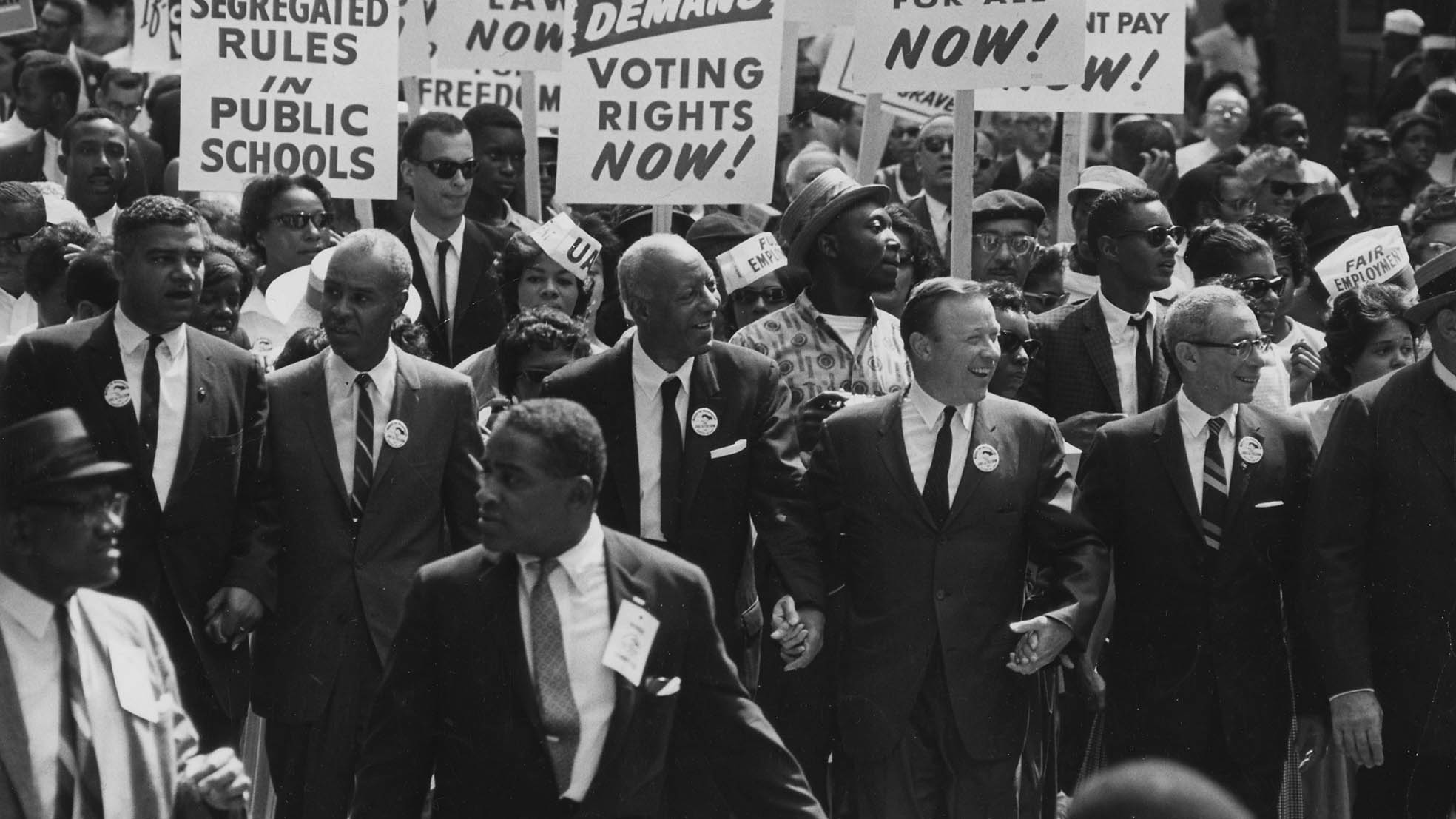
Respectability politics has long circumscribed the Black American experience and the literature produced by Black communities. This course examines some of the earliest examples of that literature to understand where, how, and why protest emerged in African American literature as a strategy to combat American racism and state-sanctioned violence.